Showing posts with label food. Show all posts

Wednesday, January 21, 2009

Manicotti and Musketeers

There is a restaurant on Arthur Avenue in the Bronx that advertises “Fine Family Dinning.” Does that mean you can bring the kids and let them make a racket? Is “dinning” like “dimming”? Or more like “dunning”? Neither of those sounds good to me. What does sound good is, “Hey, I’m going up to eat at Dominick’s on Arthur Avenue. You want to join me?”

I did have the pleasure of eating at Dominick’s this past weekend with my brother, father, and L. We combined the gustatory delights of that menu-less family-style Italian eatery with a basketball game at Fordham, vs. Xavier. Our cousin Mike is a trainer for the Musketeers and, as always, it was nice to see a friendly face on the opposing team’s bench. Go Rams! [Photo is a little fuzzy because either a) the kind woman sitting near us was sitting in a Sharper Image chair when she took it; b) the lens was covered with castor oil; or c) pick 'em.]


Dominick’s, for those unfortunate many who have not had the pleasure, is a treasure of the Bronx’s Little Italy neighborhood, a collection of bakeries, restaurants, specialty stores, and the like. Some of the restaurants have fine dinning, others no. Regardless, as yet another outpost of il bel paese, Arthur Avenue ranks with Court Street in Carroll Gardens, Brooklyn, and the most famous Little Italy in NYC centered around Mulberry St. in lower Manhattan. 2009 – a year to shake off lethargy and explore those infrequently visited spots of your place in space. A hedgerow, a side street, a nearby valley, a borough. Get out there! Don’t forget your decoder ring.

And watch out for misspelled signs. They’re everywhere.

++++++++++++++

One sign you could not miss today:

C. H. A. N. G. E.

As one blogger put i: Black president, y'all.

Friday, November 16, 2007

Let my steeple snow!

Language students are frequently reminded to notice cognates. But as with the Ides of March, beware the false cognates! One student studying in Chile, as urban legend has it, was taken to the hospital after a series of fractured conversations with her host family. She wanted to say, “Yes, I’m sorry. I feel so embarrassed.” Embarazada, right? In Spanish, embarazada is pregnant. Not embarrassed. Occhio!

Besides hospital visits, there are of course many reasons to learn another language. Ordering in a restaurant or discussing food can also be fraught with danger. Mark relates a story of his first summer here in Italy when responded to a question about his favorite recent meal by saying that he had really enjoyed i cappellini. “Really?” “Yes, i cappellini were very tasty.” Now, capellini is angel hair pasta but maybe only in the United States? And yes, the two ps make a difference in Italian. Mark’s friends soon informed him that he had been extolling the gustatory virtues of “cute little hats.” Maybe they were just pulling his gambe...

Living in a country where English is mostly an amateur sport, I have had ample time to consider language. As many of you know, I taught in an English/Spanish bilingual classroom in New York City for two years. Through that experience and my graduate studies, I learned more than I want to remember about BICS v. CALP, comprehensible input, Krashen’s theories on the stages of second language acquisition and the psychology of affective filters, and... Sorry, the dormant grad student in me took hold of the keyboard there for a moment.

Recently I have been curious about focusing on my own Italian language development. Through self-examination I thought perhaps light could dawn on Marblehead, to use an old New England saw. I turned to an old stand-by, the Student Oral Language Observation Matrix (SOLOM), which assesses five categories: Comprehension, Fluency, Pronunciation, Vocabulary, and Grammar. The matrix is scored on a scale of 1 to 5, where 1 signifies “has no proficiency” and 5 means “approaches native fluency.”

To improve the accuracy of the test, I tried to approximate lifelike testing conditions. I installed a speaker on the wall that occasionally spit loud gibberish. I taped some of my artwork and a recent spelling test by the window. I instructed my roommate to throw erasers at me. For breakfast I ate three pounds of Twizzlers. After the test, I decided that I rate a high 2 or low 3. I scored especially well on Comprehension, not surprisingly as this area is usually the first to develop.

My Vocabulary is okay, given the number of cognates from English and Spanish. But there is certainly room for improvement. I give you Example #1, translated from the Italian, in the case for “This guy often doesn’t know what he’s talking about.”

My Italian friend and I were talking in a bar.
Me: “Look at those Jews over there.”
Friend: “Excuse me?”
M: “Yeah, those two Jews over there are crazy, huh?”
F: “Ummm... What do you mean?”
M: “Look at them. They’re talking loudly, gesturing wildly, making a scene. [Snort] Jews.”
F: “What?!”
M: “Those two Jews. Yikes. That’s embarrassing.”
F: “......... No. Not Jews – drunks. They’re drunks.”
M: “Uh... right. Drunks. Thanks.”

Obviously in English this would be an egregious offense. In my defense, however, the words are close in Italian. You be the judge: ebraico – Jewish; ubriaco – drunk. A related note: this “Italian Friend,” who speaks English well, had thought for years that the Beatles had been singing, “Hey, Jew, don’t make it bad. Take a sad song and make it better...” The Chosen People are everywhere!

For more fun with words, I recommend a site I found through friend Bleeding Espresso. Free Rice - a vocabulary game that rewards achievement with donations to the United Nations World Food Program.

Wednesday, November 7, 2007

The quickest way to a man's heart

Cypress trees ring the early evening sky. The air hangs with the smell of sulfur. Steam floats off down valley in the growing dark. I’m floating, boca arriba, in the thermal baths of Bagno Vignoni. In Tuscany. On cloud nine. How did I get here?

While Italians don’t really celebrate Halloween, All Saints’ Day is a national holiday. Because it fell on a Thursday this year, most Italians took one of their favorite (among many) liberties and stretched the day-off into a four-day weekend. Fare il ponte – to make the bridge. Mark and I traveled south to Pienza in Tuscany with friends from the baseball team and a few others, some of whom who have been visiting the area regularly for ten years. Mark and I agree it is one of the best ways to travel in Italy: go with Italians who know where to go, where and what and how to eat and drink, who to talk to, what to see, etc. Thanks especially to our de facto tour guides Bodo, Moris, and Panno.
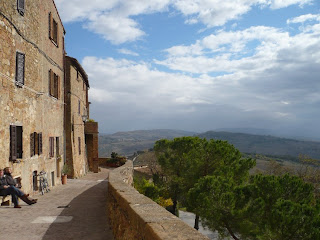

Cloud nine is a big place full of many wonders. I cannot hope to cover our trip adequately, especially not in one post. My best advice: go and see for yourself. Tuscany is magical and it calls to you.

First, let me start with our meals, since that was one of the central motivations for the trip. As with small vehicles, contour plowing, and wiffle ball stadiums, Tuscans do food very well. Perhaps too well. If I lived there the way we lived this weekend, I wouldn’t live very long. I would probably drown in the thermal baths, satiated on homemade pasta and locally-produced wines.

Eating with honorary locals Bodo and Moris, we were often that group at the various restaurants we visited: 7 guys, talking exuberantly, sitting for hours at a table that had been reserved weeks ago and marked with a little card, ordering the entire menu, turning heads of less-informed and un-local-tour-guide-blessed tourists, joking with the waiters, calling out to the owners on a first-name basis, laughing at each other and the rubes who thought they could merely walk up and get a table (most of the restaurants we ate at had between 5 and 10 tables; all were bursting with patrons), eating enough to sink small ships, and drinking enough wine to float ‘em back up.

Here is a sampling of what we ate. Most of it was “four stars heartily shake the hand of the chef” good. Some of it was “call the cemetery and reserve a spot because I can now die and go to heaven” good. These are of course subjective descriptors and will require further research to refine. I have tried to list them as best as possible in the order in which they would be eaten during a meal. Yes, sometimes we ate the vast majority of things on this list at one sitting. I wish I had photos of all of these dishes to share, but I was too busy eating to remember my camera.

- crostini: small pieces of bread toasted with toppings: olive spread, liver pâté, pecorino (sheep’s cheese, also known in Tuscany as cacio) with chopped nuts, pecorino al tartufo (cheese flavored with truffle , a good example of how man was not born to live on bread alone)

- bruschette: another toasted bread dish, familiar to most, addictive to many; the difference from crostini seems to be that the bread is toasted first and then topped with tomatoes and olive oil, pecorino al tartufo, ricotta and green onions

- salumi misti: mixed cuts of cured meats – salami, prosciutto, culatello (another type of prosciutto), capicola, bresaola, lardo (yes, lardo) - Tuscany, or anywhere in Italy for that matter, is not the best place to keep kosher AND sane

- salad with salsa di acciughe (anchovy sauce)

- zuppa (soup) with pane (bread), fagioli (beans), olio (olive oil), pepe (black pepper), and erba cipollina (chives, or, literally, green little onions)

- cipolle al pane: onions with bread chunks, baked in the oven in terra cotta dishes (a common technique used to perfection in Tuscany)

- pecorino fresco con pancetta: fresh sheep’s cheese (there are three general categorizations of pecorino, which I hope to cover in a future post) baked in the oven with bacon – perhaps both the tastiest and least healthy food I ate all weekend – wow.

- salsiccia alla griglia: grilled sausage

- pici: a homemade pasta special to Tuscany, rolled between the hands, long like spaghetti but thicker; with cinghiale (wild boar) ragu, with briciole (bread crumbs), with aglio and pomodori (garlic and tomatoes). I would probably eat this pasta with mulch or gravel or newspaper pulp. It is wicked good.

- tagliatelle: another homemade pasta, often served with a meat sauce

- maialino di latte: roast suckling pig, served with some of the subcutaneous layer of fat – tasty but not my favorite

- semifreddi: ice-cream-esque dessert that comes in slices like bread

- cantucci e vin santo: small almond biscotti, that may or may not be baked feathers from angel wings, and dessert wine traditional to Tuscany – I think Heaven may be a piazza where you sit all day drinking caffe, eating pecorino, reading La Repubblica, writing postcards, drinking vin santo with cantucci, watching stylish women walk by in stivali (boots).

Stay tuned for more reviews from la Bella Toscana.

Thursday, October 18, 2007

Wait. They eat those too?!

"Contrary to what Weston asserts, the habit of photographic seeing - of looking at reality as an array of potential photographs - creates estrangement from, rather than union with, nature." - Susan Sontag

Susan Sontag may not have actually written this. In fact, she probably did not. Mark Danielewski did, put her name on it, and included it as an epigraph to a chapter in his mad, maddening book The House of Leaves. I don't know about abandoning hope, but definitely tread carefully if you enter there. Having just finished the book, I can tell you that the estrangement is real.

So are the following photos. I can vouch for their authorship. They require neither doctoring nor, in some cases, explanations. Together and individually, they highlight aspects of the Italian nature around me. Some are estranging, while some are merely strange.
*******
Maybe this refers to some other sport. Or a place. Or maybe it's a rare error and is worth more. Or spelling is not what it used to be. [Clothing differences could be a whole series, with Italian t-shirt slogans and the like occupying multiple volumes.]

*******
"Watch out for the man in the low-rider bulldozer!"
Or maybe: "Be excited! The man in the small, open cockpit bulldozer is coming!"

*******
Airline ticket, Chicago to Florence: $750.
Rental car for one week: $280.
Rick Steve's Italy 2007 Guidebook: $14.95.
Delicious lunch for two of wild boar proscuitto, angel hair pasta, and local red wine: $60.
Suggested donation at quaint, historic churches in small Tuscan hillside towns: around $3 total.
Going home from your Italian vacation with a replica Confederate flag: priceless.


*******
An example of Italian ingenuity. Like with climbing skins, wooden clogs and sushi, I at first found the practice strange and am now a convert.

As this photo illustrates, many Italians lean their kickstandless bikes on curbs or steps to keep them upright. Sometimes, people leave their bikes like this on busy streets, in say downtown Florence, creating traffic issues, but that's another whole can of bachi. My question is, do you need to do this when your bike already has a kickstand? From my initial surveys, the answer would appear to be a resounding yes. The bike-pedal-on-curb technique must be used at no times less than all.
*******
Lastly... fill in your own punch line.