Showing posts with label traveling. Show all posts

Tuesday, December 4, 2007

Birds, beauty, perambulations, and a bottom feeder

Walking the Florentine streets, we came across many things of interest. A few Irish pubs selling Kilkenny, a great Irish beer that is unfortunately not exported to the U.S. My mother’s new favorite digestif, limoncello – a sweet essence of summer lemon groves liqueur that may be the closest drink we have to Ray Bradbury’s dandelion wine. Christmas lights strung across the narrow streets, lighting the window shoppers, low-hanging constellations in blue and white. Taking the advice of my brother’s roommate, we took special care in crossing the streets – many Florentines zip through the city on scooters like rabbits late for very important dates – occhio!

In Piazzale Michelangelo, above the city and across the river, a green copper copy of the David stands above kitsch booths and buskers – we heard delicate classical guitar played by a focused youth with his back to the views. This piazza and the cemetery higher up on the hill are not to be missed.

From the banks and bridges of the river Arno, we caught frequent glimpses of the Duomo and the crenellated tower of the Palazzo Vecchio, admired skullers from the world-champion Florentine crew club and the reflection of Ponte Vecchio on the still waters of a cloudy day. My brother and I also saw some locals feeding imperial Roman quantities of bread to a flock of pigeons and a family of nutria – rats of the sky and rats of the water. Brilliant.


Perhaps the oddest aquatic sight was the giant catfish we saw pulled from the river by Hemingway’s Italian old man. I would not have thought such a beast possible in those waters. Leaving the fish up from the water’s edge, the fisherman waded back to shore through a whorl of gulls. He was loaded down with long rods, a cooler, a net large enough to seine for shrimp. He rode off on his bicycle and we did not stay to see whether or not he returned for his catch.

Monday, December 3, 2007

Revisiting Siena

During my family's visit last week, we took a day trip by bus, through fog, to the Tuscan jewel Siena. Because of the Bubonic Plague and its long history in the shadow of her busier rival, Florence, Siena has retained her medieval structure, feel, traditions, and politics more significantly than many other places in Italy. I visited in August for the Palio, perhaps the most famous bareback horse race in the world, and it was a pleasure to go back with my family. Thanks to the excellent introduction to the city I received from Magno (like our favorite team, the Red Sox, sempre campeon), I was able to play tour guide for part of the day. And what a day it was. The winding labyrinthine streets of the contrade. The elegant striped and unfinished Duomo, home of an amazing marble floor and a stargazing scriptorium. The sloped scallop of the picturesque Campo, site of the biannual race and a perfect setting for a late afternoon drink. A wandering ramble past churches, the university, vistas, the calcio stadium, leather and paper and ceramics and artisan shops, eventually back to the bus station. Here are some of the many photos we took.

Friday, November 30, 2007

Trading post cards for boarding passes

For Thanksgiving this year, I ate no turkey and watched no American football. There were no pumpkin pies cooling in my kitchen, no traditional Quaker hymns sung across generations. I did receive a gift beyond worth when my parents and brother came to visit for a week. We spent our time together in Tuscany, mostly in Florence with a day-trip to Siena. We rambled and ambled, wined and dined, raptured at art and city and captured moments on film. To avoid gluttony of reading and writing, I will try to describe the vacation in installments. Hey, it worked for Dickens and Matthiessen, right?

The Uffizi. A grand palace with an overwhelming collection of art. Countless Adoration of the Magi; innumerable Madonnas, including Madonna of the Pomegranate, the Long-necked Madonna, and a dark 15th century portrait that reminds me now of Munch, found by museum representatives at a flea market in Milan in 2002. I learned about the martyrdoms of various saints: Sebastian killed by arrows, Florian thrown from a bridge with a millstone chained to his neck. Many of the Masters are there: Caravaggio, Botticelli, Raphael, da Vinci, Michelangelo, Giotto, Titian, Dürer... Having now traveled a bit in Italy, I recognize its plants, architecture, and landforms in Renaissance art: who knew that Bethlehem looked just like the Tuscan countryside? At night, the city sparkles along the river and the dome of the cathedral still boggles the mind despite the shadows.

The Accademia. We lucked out and, with the combination of a slower tourist season and an afternoon rainstorm, walked right in without waiting in line. The pen-and-marker graffiti along the wall lining the sidewalk attest to the expectant purgatory of visitors past. The small museum has one room of amazing paintings and another exhibition area of musical instruments from the Medieval and Renaissance periods. However, the gallery’s main attraction is Michelangelo’s David, and rightly so. A few unfinished sculptures precede the David and show some of Michelangelo’s process and genius. The 17-foot tall David is... Giorgio Vasari, Michelangelo's contemporary and biographer, said: "Whoever has seen this work need not trouble to see any other work executed in sculpture, either in our own or other times, by no matter what craftsman." The stone seems more alive than some people I’ve known. I had to remind myself of optical illusions when I saw his chest swell with breath. With tired feet and a curious mind, I was happy to sit and stare for a long time. To think that Michelangelo completed the sculpture by the time he was thirty...

Wednesday, November 14, 2007

Islands in the Stream, Part III

The last installment of Mordecai's essay...

******

Pius II’s efforts towards the creation of a utopia in the hills of Tuscany are often glossed over by historians of theology, the Crusades, and the political foundations of modern Europe. It has particular resonance for historians of sport, however, and there is a growing body of research on Pius the Sportsman. Some grants have been awarded in support of further studies of Pius II’s practice of falconry, for example, but, given the prevalence of that activity during the early Renaissance period, more adventurous historians have set their sights elsewhere.

While the evidence is scant, some historians are beginning to assert that Pius II was an ardent practitioner of a much-practiced yet oft-maligned sport: Wiffle Ball. Yes, Wiffle Ball – a variation on baseball that is played using a lightweight, perforated plastic ball, almost invariably white in color, and an invariably yellow plastic bat. Groundbreaking historians in this field, including Hampton, Grieves, et al., now claim that Pius II’s fascination for and dedication to the sport of Wiffle Ball were so great that he designed the central piazza of Pienza to be a Pantheon for its dedicants.

Centuries later, a group of us made good on Pius’ promise to Wiffle athletes. On our recent trip to Tuscany, we played Wiffle Ball in Pienza’s historic central piazza. Crazy, yes, but true. We found many pieces of Pius II’s grand Wiffle Ball stadium still in place and were frequently surprised by the overarching beauty of his plan. The locker room/dugout along the wall of one abutting palace, replete with hooks for jackets. The batting practice cage alongside the ancient well. Infield/outfield practice from the lip of the central door. A perfectly placed circle bricked into the very pattern of the piazza from which the pitcher could serve up Wiffle junk.

The lights shone bright on our field. Tickets were scalped to disbelieving neophyte fans for free – we were putting on a show and inviting all of Tuscany, even the papal ghosts, to join us. Except for when the municipal police rolled by: some of us scattered like high schoolers caught loitering in a midnight parking lot; one of us waddled off with the Wiffle Ball bat running the length of his leg. Our official photographer documented the scene. We laughed at the spettacolo and improbability of it all: Wiffle Ball in the House that Piccolomini Built for Wiffle Ball. A fitting sequel to the Lake Como Cup of 2006.

[For a fuller treatment of Pius II’s fascination with American sports invented, allegedly, after his death, I encourage you to read Jackson Checo’s thorough and impeccably researched examination of the subject, Piccolomini: The First Suburban Teenager?]

Tuesday, November 13, 2007

Islands in the Stream, Part II

Mordecai's essay continued...

*******

The Leibnitz party thought they had found their parcel of the Promised Land, but the island proved barren despite their efforts. Within a fortnight it became clear that it was not even, in fact, a true island, as the spring Proxigean tides soon inundated the small space, leaving but a speck of damp sand “the size of a rolltop desk (Adão, ed., 1957).” By that point, the party was over, and Leibnitz was the only remaining guest.

One of the last to depart, Maggie Oswald, claimed, in her interview with the New Bedford Daily Register, that Leibnitz was attempting to construct “a platform of some sort, from any which flotsam and jetsam and the like that happened by. I saw a lobster pot he had, and a shipping palette, an empty rum barrel from a pirate ship I think, a big bone maybe from a moose, a split plank flower box... I don’t know. It didn’t look real stable (Adão, ed., 1957).” Colorful as this description may be, Ms. Oswald’s report was certainly influenced by the severity of the ordeal she had just endured and unfortunately could not be verified.

Any attempts to corroborate her story of Leibnitz’s unusual tower were thwarted when, within a few days, an unseasonal hurricane swept up the North Atlantic coast. While meteorological records from the period indicate a low-force storm (Davis & Davis, 1922), by the time the weather had cleared, Leibnitz, the accordion, the two sheep, any platform, and the first ten feet below sea level of the island had disappeared. At the University of Maine at Orono-hosted symposium “Is Any Man an Island?: A Discussion on the Hermeneutics of Ill-Fated Utopian Expeditions of the 19th Century,” Dutch researcher Jan-Mendelt Van Wristler commented, “It is doubtful Leibnitz survived.” Indeed. Another arrow shot at the moon that fell well short.

Whether or not Leibnitz knew of Pope Pius II (1405-1464) is a subject of some debate among utopian historians. However, they both held la città ideale of More and Plato in high esteem: Leibnitz played out his tragedy along the Massachusetts coast; Pius II used the Tuscan countryside as his palette. What is generally agreed upon is that Pius II was “born Enea Silvio Piccolomini in1405. [He] was Pope from August 19, 1458 until his death in 1464. Pius II was born at Corsignano in the Sienese territory of a noble but decayed family. His longest and most enduring work is the story of his life, Commentaries, which is the only autobiography ever written by a reigning Pope.”

Strongly influenced by the humanists of his day, Pius II set out to resculpt his hometown, and this aspect of his papacy is of special interest to historians of urban design. Corsignano, later renamed Pienza in honor of its most famous son, became the first formidable exercise in city planning in post-plague Europe. The town still retains most of the fruits of his labor and was designated a World Heritage site by UNESCO in 1996.

Monday, November 12, 2007

Islands in the Stream, Part I

On my recent trip to Tuscany, I traveled with my roommate Mark and a collection of characters associated with his baseball team. We also spent some time with an acquaintance of mine from New York, Mordecai Johnson, who is a visiting adjunct professor at the University of Bologna. He asked if he could contribute some historical perspective to my blog, and I readily agreed. Because of the length of Mordecai’s essay, I have separated it into three installments.

**********

The desire for utopia has engendered many attempts at the ideal community. Plato’s Republic and Sir Thomas More’s Utopia are justly the most famous literary antecedents. In Massachusetts of the 17th century, the Puritans believed they were establishing a “city upon a hill” that might serve as a beacon to the world. Many sought a counter-example to the increasingly teeming cities of the Industrial Revolution during the 19th century. Within this last category, the story of Arnold Leibnitz provides an especially telling example. While peculiar, the story is by no means unique; the Leibnitz party and a trove of other foolhardy experiments share a common result: failure.

Leibnitz was in many ways the archetypal aspiring utopian leader: charismatic, prematurely grey, neglectful of quotidian minutiae. With a small group of like-minded souls, Leibnitz set off from Boston in mid-March of 1857 on what was then an arduous overland journey to Provincetown, Cape Cod. Inspired by Leibnitz’s creative firebrandery, they hoped to form a utopian community apart from “the roiling mess of present society (Rosenfeld, 1975).” By early April, however, having established nothing more than poor relations with the local inhabitants, the group was run out of town. Though first-person accounts vary wildly in their depiction of the Leibnitz party’s exodus, there is a general consensus that the group was lax in paying bar tabs and maintaining personal hygiene.

Finding themselves with “but a skiff and a sack of potatoes to their collective name” (Lister, 1964), the group gathered on a dune to regroup. Eventually, after much deliberation and not a little ill will, the latter primarily directed towards the accordionist in the group, Leibnitz decided to lead the party out to a small, uninhabited island he saw just off-shore. Gesturing vociferously, he proclaimed, “There, amidst the unspoilt bosom of Nature, we shall settle and make famous our experiment (Kalantagian, 1981).”

Clamoring into the skiff, one and all with potatoes and accordion and two sheep – the reasoning being that most in the party enjoyed their tea with milk and that come fall they could “make what harvest we could from the wool of our flock” (O’Leary, 1980) - the group splashed out towards the island. They made landfall on Accordion Island, so named for completely unrelated circumstances, after over four hours of drifting caused by the group’s having neglected to bring any means of propulsion or steering and to “Poseidon’s cruel sense of humour [sic]” (Ferthen, 1917). Splashing ashore, Leibnitz fell immediately to his knees in prayer to God, Shiva, and the animist spirits of the island, it being an ecumenical endeavor...

Wednesday, November 7, 2007

The quickest way to a man's heart

Cypress trees ring the early evening sky. The air hangs with the smell of sulfur. Steam floats off down valley in the growing dark. I’m floating, boca arriba, in the thermal baths of Bagno Vignoni. In Tuscany. On cloud nine. How did I get here?

While Italians don’t really celebrate Halloween, All Saints’ Day is a national holiday. Because it fell on a Thursday this year, most Italians took one of their favorite (among many) liberties and stretched the day-off into a four-day weekend. Fare il ponte – to make the bridge. Mark and I traveled south to Pienza in Tuscany with friends from the baseball team and a few others, some of whom who have been visiting the area regularly for ten years. Mark and I agree it is one of the best ways to travel in Italy: go with Italians who know where to go, where and what and how to eat and drink, who to talk to, what to see, etc. Thanks especially to our de facto tour guides Bodo, Moris, and Panno.
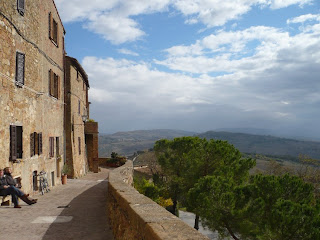

Cloud nine is a big place full of many wonders. I cannot hope to cover our trip adequately, especially not in one post. My best advice: go and see for yourself. Tuscany is magical and it calls to you.

First, let me start with our meals, since that was one of the central motivations for the trip. As with small vehicles, contour plowing, and wiffle ball stadiums, Tuscans do food very well. Perhaps too well. If I lived there the way we lived this weekend, I wouldn’t live very long. I would probably drown in the thermal baths, satiated on homemade pasta and locally-produced wines.

Eating with honorary locals Bodo and Moris, we were often that group at the various restaurants we visited: 7 guys, talking exuberantly, sitting for hours at a table that had been reserved weeks ago and marked with a little card, ordering the entire menu, turning heads of less-informed and un-local-tour-guide-blessed tourists, joking with the waiters, calling out to the owners on a first-name basis, laughing at each other and the rubes who thought they could merely walk up and get a table (most of the restaurants we ate at had between 5 and 10 tables; all were bursting with patrons), eating enough to sink small ships, and drinking enough wine to float ‘em back up.

Here is a sampling of what we ate. Most of it was “four stars heartily shake the hand of the chef” good. Some of it was “call the cemetery and reserve a spot because I can now die and go to heaven” good. These are of course subjective descriptors and will require further research to refine. I have tried to list them as best as possible in the order in which they would be eaten during a meal. Yes, sometimes we ate the vast majority of things on this list at one sitting. I wish I had photos of all of these dishes to share, but I was too busy eating to remember my camera.

- crostini: small pieces of bread toasted with toppings: olive spread, liver pâté, pecorino (sheep’s cheese, also known in Tuscany as cacio) with chopped nuts, pecorino al tartufo (cheese flavored with truffle , a good example of how man was not born to live on bread alone)

- bruschette: another toasted bread dish, familiar to most, addictive to many; the difference from crostini seems to be that the bread is toasted first and then topped with tomatoes and olive oil, pecorino al tartufo, ricotta and green onions

- salumi misti: mixed cuts of cured meats – salami, prosciutto, culatello (another type of prosciutto), capicola, bresaola, lardo (yes, lardo) - Tuscany, or anywhere in Italy for that matter, is not the best place to keep kosher AND sane

- salad with salsa di acciughe (anchovy sauce)

- zuppa (soup) with pane (bread), fagioli (beans), olio (olive oil), pepe (black pepper), and erba cipollina (chives, or, literally, green little onions)

- cipolle al pane: onions with bread chunks, baked in the oven in terra cotta dishes (a common technique used to perfection in Tuscany)

- pecorino fresco con pancetta: fresh sheep’s cheese (there are three general categorizations of pecorino, which I hope to cover in a future post) baked in the oven with bacon – perhaps both the tastiest and least healthy food I ate all weekend – wow.

- salsiccia alla griglia: grilled sausage

- pici: a homemade pasta special to Tuscany, rolled between the hands, long like spaghetti but thicker; with cinghiale (wild boar) ragu, with briciole (bread crumbs), with aglio and pomodori (garlic and tomatoes). I would probably eat this pasta with mulch or gravel or newspaper pulp. It is wicked good.

- tagliatelle: another homemade pasta, often served with a meat sauce

- maialino di latte: roast suckling pig, served with some of the subcutaneous layer of fat – tasty but not my favorite

- semifreddi: ice-cream-esque dessert that comes in slices like bread

- cantucci e vin santo: small almond biscotti, that may or may not be baked feathers from angel wings, and dessert wine traditional to Tuscany – I think Heaven may be a piazza where you sit all day drinking caffe, eating pecorino, reading La Repubblica, writing postcards, drinking vin santo with cantucci, watching stylish women walk by in stivali (boots).

Stay tuned for more reviews from la Bella Toscana.

Thursday, October 18, 2007

Wait. They eat those too?!

"Contrary to what Weston asserts, the habit of photographic seeing - of looking at reality as an array of potential photographs - creates estrangement from, rather than union with, nature." - Susan Sontag

Susan Sontag may not have actually written this. In fact, she probably did not. Mark Danielewski did, put her name on it, and included it as an epigraph to a chapter in his mad, maddening book The House of Leaves. I don't know about abandoning hope, but definitely tread carefully if you enter there. Having just finished the book, I can tell you that the estrangement is real.

So are the following photos. I can vouch for their authorship. They require neither doctoring nor, in some cases, explanations. Together and individually, they highlight aspects of the Italian nature around me. Some are estranging, while some are merely strange.
*******
Maybe this refers to some other sport. Or a place. Or maybe it's a rare error and is worth more. Or spelling is not what it used to be. [Clothing differences could be a whole series, with Italian t-shirt slogans and the like occupying multiple volumes.]

*******
"Watch out for the man in the low-rider bulldozer!"
Or maybe: "Be excited! The man in the small, open cockpit bulldozer is coming!"

*******
Airline ticket, Chicago to Florence: $750.
Rental car for one week: $280.
Rick Steve's Italy 2007 Guidebook: $14.95.
Delicious lunch for two of wild boar proscuitto, angel hair pasta, and local red wine: $60.
Suggested donation at quaint, historic churches in small Tuscan hillside towns: around $3 total.
Going home from your Italian vacation with a replica Confederate flag: priceless.


*******
An example of Italian ingenuity. Like with climbing skins, wooden clogs and sushi, I at first found the practice strange and am now a convert.

As this photo illustrates, many Italians lean their kickstandless bikes on curbs or steps to keep them upright. Sometimes, people leave their bikes like this on busy streets, in say downtown Florence, creating traffic issues, but that's another whole can of bachi. My question is, do you need to do this when your bike already has a kickstand? From my initial surveys, the answer would appear to be a resounding yes. The bike-pedal-on-curb technique must be used at no times less than all.
*******
Lastly... fill in your own punch line.

Saturday, October 13, 2007

Travelin', parte quattro

Bella Roma. Mark and I went down to Rome late Friday to meet his parents and his family friends Jane and Terry before they all headed back to the States. After a long and convoluted trip, we arrived at the plush hotel [note to self: be sure to travel when possible with people who like to stay in fancy places] in time to go to bed.

In the morning, Mark and I set out on what will easily be one of the most memorable and certainly most historic runs I will have the pleasure of running in in my life. As an introduction to Rome, it sure beats the sardine-can red tourist buses with the open tops. The city speaks for itself, but it also helped that Mark lived in Rome for a few months back in 2005. In addition to the echoes of Caesars, Michelangelo, fratricide, and il Duce (no, New Yorkers and Chicagoans, I’m not talking about a 53-year old Cuban pitcher with a high leg kick), Rome holds memories ‘round most corners for Mark. Running tour guide anyone? Mark almost worked as exactly that when living in Rome; luckily he ran with me for free.

Approaching from the west, Mark and I ran towards the newly risen sun; stopping in front of the Acqua Paola fountain, we tried to catch our breath only to have it whisked away by the view of the city stretched out before us, throwing off its nighttime blanket of mist and haze. Dropping down the hill into the city, Mark and I ran past many of the nearly infinite famous sights of Rome: the Coliseum, the forerunner of nearly all modern sports’ stadiums, looking like she could still host some games; the Forum, the Circus Maximus and the Palantine Hill; along the Tiber River; countless piazzas, including the Piazza del Campidoglio with its geometric paving, surrounded by the Capitoline Museums, which opened to the public in 1734. Last time I checked, we in the colonies were still operating under a pre-mercantilist economy at that point, 40 years off from our own first museum – though work may have begun on the Giles Corey mannequin in Salem, MA.

The home stretch of our run led us through Rome’s largest landscaped park, Villa Doria Pamphili. After the enrapturing maze of alleys and monumented thoroughfares, Mark and I were thrilled to run free like gazelles (or water buffalo, depending whose stopwatch you trust). It is a gorgeous park that curves along the crests of hills south of Vatican City, full of historic villas, African savanna trees and grasses, Romans exercising, a hedge maze, space.

After a stout breakfast at the hotel, we merry band of six set out to conquer Rome. We walked approximately 72 kilometers, each of us wearing through at minimum two pairs of shoes. We revisited many of the sights on the morning run itinerary, this time at walking pace and with the requisite POSes (photo opportunity stop) every 7 feet. Other highlights included the requisite Trevi Fountain and Spanish Steps; tap-dancing buskers in Piazza Navona, which may house the first instance of sculpture as a medium for trash talking; the Pantheon, which is the most pagan-temple-feeling church I’ve ever been in; peeking through the window at World Cup rugby outside the Abbey Theatre Pub; the sun setting behind the Coliseum; the church of Santa Maria in Aracoeli and her long staircase, built at the end of the bubonic plague. An unusual way to celebrate maybe, but a beautiful setting.

In full disclosure, I was in Rome for all of 36 hours and found nearly everything beautiful. During the weekend, Ray Allen, a new addition to the Boston sports pantheon (more on that in a moment), was stopped by a Roman policeman for riding his scooter into a no-drive zone. In the related article, Ray is quoted as saying, "Wow! What a city! They keep their ruins!" Yes, there is a lot to see and I clearly need to return.

The question of the hour is: Will I ever again have the opportunity that occasioned our visit in the first place? Boston Celtics. Playing the Toronto Raptors. In Rome. Yes, it was a pre-season exhibition game, and yes, the starters didn’t play the entire fourth quarter, and yes, there was no organ player pumping up the crowd but... a) the cheerleaders are already in great form; b) team mascots dunking a basketball by launching themselves improbably through the air off of trampolines looks cool in any language; c) Paul Pierce is a beast; and, most significantly, d) Kevin Garnett is an even bigger beast and has single-handedly upped my caring factor for the NBA to Code Orange. Or something higher than it was before.


In addition to living la bella vita en bel paese with a lifelong friend who triples as jogging tour guide, link to fun-loving, bank-rolling parents, and Italian slang translator, I get to be a Boston sports fan during an unusually giddy period. If I pinch myself anymore, I won’t have any pinches left for the babies when I throw my hat in the ring for the 2016 Presidential election. Go Sox, Pats, BC Eagles, et al.

Mille mille grazie to the Langones for including me in their vacation. Here are some photos from the whirlwind day.

Friday, October 12, 2007

Travelin', parte tre

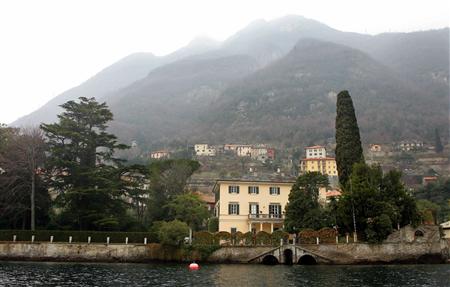
Lake Como. Mark’s parents were gracious enough to invite Mark and I to join them in Lake Como for a few days. Which is another way to say that they were spoiling us. The hotel had many stars and a stellar location; to the right, for example, is the view from our room's balcony, with the dome of the cathedral, or Como's Duomo, just visible down the lake. As the Red Sox specialize in winning and pirates specialize in swarrrrrthiness, Lake Como specializes in breathtaking views.

At times we comprised a party of nine, with Mark’s sister, our friends Chris and Glee, and Mark’s godmother Terry and her friend Jane rounding out the group. While not the Greatest Show on Earth, we may have been nominated for Oscars in the following categories: Best Comedic Ensemble (Group); Best Actor in a Role Limited to Nighttime Activities (Mark works late); Best Soundtrack (ya gotta love familiar voices from home, especially when they ring with Boston-area accents); and Best Actress Duo Impersonating Laverne and Shirley (Terry and Jane’s starring roles, as themselves).

The town of Como seemed to be in post-summer slowdown, which was fine with me as I am developing a fondness for off-season travel. We strolled the streets of the old town in the rain. We had a great lunch and admired the duomo. The green copper roofed rises impressively above the town as the latter crowds towards the water, making it seem that all the buildings want to take a dip in the lake. But nobody brought their suit.

On a long Saturday morning run with and without Michelle (she is also training for a marathon, her 17th, and ran farther than I did), I had to remind myself frequently to watch my step out of concern for the effect the unfolding views might have on my pedal locomatory coordination. We ran through a botanical garden, around many rotaries, past 17th-century palaces and cigarette boats - speedboats also know apparently as “go fast boats.” [There was a race later the day we left and I honestly thought about changing my ticket.]

Throughout our entire stay, we ate like royalty. If you’re ever in Brunate, a short funicular ride straight up from Como, and are eating in a restaurant that seems impossibly perched on the edge of a precipitous drop, enjoying the view and telling yourself to forget the effects of gravity on unsupported patios, be sure to try the wild boar and venison prosciutto. They’re excellent.

If you’re ever in Bellagio, a short or long ferry ride from Como (depending if you take the direct Discovery Channel-worthy hydrofoil boat or not), and have built up a sufficient appetite from strolling hillside shops and craning your neck looking for George Clooney’s lakeside villa, I recommend trying the wild mushroom fettucine. That is, if you can manage to chew with so much jaw-dropping beauty around you.

Riding the ferry up the lake, I could see easily why Mr. Clooney and others across the centuries have chosen to live there. The steep verdant hills caught shreds of fog and clouds and held them quiet in narrow river-run valleys. The towns that rest along the shore at intervals looked colorful and calm from the boat. On the distant horizon to the north wait mountains of varying heights that even in early October were beginning to wear white topcoats of snow. The narrow deep blue lake itself feels like the sinuous coast of Maine turned inside out.

Ferries, hills, funiculars, snow-capped peaks, wild boar, lakeside running paths, a short hop skip from Switzerland (you don’t even need the jump it’s so close), clean air and water. I was smitten. I took a lot of pictures.

Obviously, Lake Como is a world-class vacation destination raved about in all guidebooks on Italy and periodicals like the New York Times in their semi-official weekly travel articles on bel paese. Still, I was exuberantly surprised. Next time George calls, I won’t pretend to be busy grooming my llama.

And I’ll tell him I have just the cast of characters for Ocean’s Fourteen.

Thursday, October 4, 2007

Travelin', part deux

Early in September, I visited David and Ben, twins who attended my high school for a few years, in Geneva. Born U.S. citizens, they are both now Swiss and give evidence of the saying: When all the chips are down, you know the buffalo is empty.

Geneva. An elegant cat stretched across a hilltop soft by two rivers and a clear lake. Swans and sunbathers and efficient looking locks, parks spilling down to the lake, stunning panoramas from the cathedral tower (once a Catholic church and now a Protestant reminder of the Reform), and nearly everywhere views of the great water jet. Why shouldn’t public spaces be whimsical? A growing art scene and East Village from back when neighborhood of people claiming, inhabiting, enlivening underused space. Skateboarders whooping it up alongside a seasonal amusement park/zoo of camels and pachyderms and French-speaking carneys – and to think I saw it all on the Plaine de Plainpalais?

Geneva is an international crossroads – Julius Caesar himself mentioned it in his writing - especially for environmental and humanitarian organizations. Just a short drive away is CERN, the world’s largest particle collider, straddling the border with France and saddling up to the infinitesimal. Did you hear the one about the hadron crossing the road?...

David and I spent one afternoon hiking up up up and then doooooown on the Jura, a pre-historic ridgeline that runs up to Germany, older than the Alps. Views of Mont Blanc, stately and large; the Rhone Valley, heading south and west through a gap in the hills, a terroir of excellent wines.

I got to watch a lot of soccer, calcio, futbol. Ben still plays on the team from his home village; he also coaches the under-17 team, and David and I saw parts of both games in addition to some others. In between games on a warm Sunday afternoon, he and I squared off in yet another example of the good life, French/Swiss/Italian style: bocce or its close relative pétanque. As attendees to a cetain backyard bachelor party this summer can attest, I’m pretty good by some standards. Some standards. David wiped the floor with me. Rhone Valley 1: Merrimack Valley 0.

Cheese. The Swiss are big into cheese. One night, before watching fellow countryman Roger Federer win yet another major, the twins, David’s roommate Piero (one of the most genuinely cheerful people I have ever had the pleasure of meeting), and I ate fondue – rich, heavy, creamy cheese with a touch of white wine kick, pushing us to eat more than we thought possible.

Another night, a group of us dined in the one restaurant in David and Ben’s childhood home village, Laconnex, 500 inhabitants strong. Rugby on TV, food rich with more cheese and potatoes and meats, wines from vineyards just down the road, engaging if sometimes unintelligible companions (French remains beyond my understanding) who share a bond grown over years, and of course the after-dinner digestifs and cafes – lucky am I to have such rich opportunities and hospitable friends.

Wednesday, October 3, 2007

Travelin'

When it rains, it pours, and I've been drowning in good fortune recently. Traveling. A lot.

Pico Iyer said, about travel writing, "[You should] try to catch the feelings — the sound, the smell, the tang, of a place — immediately, before it goes. A place is like a dream, and unless you record it instantly, however tired you feel at the time, it will fade and fade, and you will never be able to recapture it."

As I am not de Tocqueville, nor am I Iyer. However, during my recent travels, I have made some attempt at capturing impressions of places. These writings are neither remotely grammatically correct nor comprehensive; I may be right or wrong, but it's my opinion you can find 'em both at the Grand Canyon, sundown...

Milano. A cookie and also a city. Much underrated and often overlooked by foreign travelers, Milan buzzes with cosmopolitan life. Unfortunately, many were the faces that drooped when I said I'd be living in her shadow - "You shouldn't move there." "Oh, other Italian cities are much nicer." "Um, two words: yuk and yuk." I disagree and find the city growing on me. Just as turkey should not try to emulate the other animals (thanks, Mitchell), so too does Milan have its own thing going. Aperitivi of delish bar food, meandering streets and grand piazzas, palazzi of historic families and fame, canals lined with cafes and bars and crossed by squared pedestrian bridges (think the Amsterdam of northern Italy, sort of). Orange trams from the turn of the 20th century still ply the streets, hinting of remembered whispers of fedoras and bespoke and war-time rationing and emigration. I stumbled across an artists’ studio school with 20 acolytes attentive to a Titianesque brunette up on a platter.

The subway runs effectively it would seem, and, like DC and the Bay Area and probably many others, the transit authority have installed electronic screens that advise of waits until the next trains [I can hear Marty Markowitz chiming in for New York: Fugheddaboutit!]. I have noted some interesting activities underground, however: numerous people wearing sunglasses; doors opening occasionally while the train is slowing to a stop; a driver over-shooting the platform by a half-car length and backing up to a stop. Motorini everywhere in all shapes, colors, and sizes – even a 4X4?! [Strangely, though, approximately 80% of all cars in Italy are silver or grey. What's going on here?]

Il Duomo rises above expectations and begs hyperbole; la Scala, on the other hand, is unassuming and easy to miss from the outside. Ah, but what sort of devotions and rapturous audiences congregate in one and the other? Further investigations will of course be necessary. I think I know just the Sherlock.

Here are some more photos of Milan if you're interested.