On my recent trip to Tuscany, I traveled with my roommate Mark and a collection of characters associated with his baseball team. We also spent some time with an acquaintance of mine from New York, Mordecai Johnson, who is a visiting adjunct professor at the University of Bologna. He asked if he could contribute some historical perspective to my blog, and I readily agreed. Because of the length of Mordecai’s essay, I have separated it into three installments.
**********
The desire for utopia has engendered many attempts at the ideal community. Plato’s Republic and Sir Thomas More’s Utopia are justly the most famous literary antecedents. In Massachusetts of the 17th century, the Puritans believed they were establishing a “city upon a hill” that might serve as a beacon to the world. Many sought a counter-example to the increasingly teeming cities of the Industrial Revolution during the 19th century. Within this last category, the story of Arnold Leibnitz provides an especially telling example. While peculiar, the story is by no means unique; the Leibnitz party and a trove of other foolhardy experiments share a common result: failure.
Leibnitz was in many ways the archetypal aspiring utopian leader: charismatic, prematurely grey, neglectful of quotidian minutiae. With a small group of like-minded souls, Leibnitz set off from Boston in mid-March of 1857 on what was then an arduous overland journey to Provincetown, Cape Cod. Inspired by Leibnitz’s creative firebrandery, they hoped to form a utopian community apart from “the roiling mess of present society (Rosenfeld, 1975).” By early April, however, having established nothing more than poor relations with the local inhabitants, the group was run out of town. Though first-person accounts vary wildly in their depiction of the Leibnitz party’s exodus, there is a general consensus that the group was lax in paying bar tabs and maintaining personal hygiene.
Finding themselves with “but a skiff and a sack of potatoes to their collective name” (Lister, 1964), the group gathered on a dune to regroup. Eventually, after much deliberation and not a little ill will, the latter primarily directed towards the accordionist in the group, Leibnitz decided to lead the party out to a small, uninhabited island he saw just off-shore. Gesturing vociferously, he proclaimed, “There, amidst the unspoilt bosom of Nature, we shall settle and make famous our experiment (Kalantagian, 1981).”
Clamoring into the skiff, one and all with potatoes and accordion and two sheep – the reasoning being that most in the party enjoyed their tea with milk and that come fall they could “make what harvest we could from the wool of our flock” (O’Leary, 1980) - the group splashed out towards the island. They made landfall on Accordion Island, so named for completely unrelated circumstances, after over four hours of drifting caused by the group’s having neglected to bring any means of propulsion or steering and to “Poseidon’s cruel sense of humour [sic]” (Ferthen, 1917). Splashing ashore, Leibnitz fell immediately to his knees in prayer to God, Shiva, and the animist spirits of the island, it being an ecumenical endeavor...
Monday, November 12, 2007


Friday, November 9, 2007
Walking on the moon with the lights turned off
 Last night I wandered through a carnival being set up in town. Here in Italy these traveling amusements are called Luna Parks, though that may be a brand name? The community of carnies is living around the corner from us and the park itself is set up just down the street. While I am certainly peripatetic, I can only imagine what a 21st century nomadic life would be like...
It was odd to walk the midway before it has opened for business, like being in school on Sunday or a ballpark in November. An amusement park with its shutters down and its plugs pulled. Flashy wheeled carts and miniature fire engines and flying horses at rest. Wooden bottles in no danger of falling boxed up. A bull roping gig set to snort steam collecting dew. Bumper cars lined up in their shawls like boats at a winter marina. Food booths linger already or still with the scent of popcorn and toasted sugar. A whirly top with flanges for seats and standing room screaming only quiet dark. All of it waiting.
Durante medio siglo
la poesía fue
el paraíso del tonto solemne
hasta que vine yo
y me instalé con mi montaña rusa.
Suban, si les parece.
Claro que yo no respondo si bajan
echando sangre por boca y narices.
- Nicanor Parra
*******
For half a century
poetry was
the paradise of the solemn fool
until I arrived
and I settled in with my roller coaster.
Go on up, if it strikes you.
Of course I won’t respond if you come down
pouring blood from your mouth and nostrils.
Wednesday, November 7, 2007
The quickest way to a man's heart
Cypress trees ring the early evening sky. The air hangs with the smell of sulfur. Steam floats off down valley in the growing dark. I’m floating, boca arriba, in the thermal baths of Bagno Vignoni. In Tuscany. On cloud nine. How did I get here?
While Italians don’t really celebrate Halloween, All Saints’ Day is a national holiday. Because it fell on a Thursday this year, most Italians took one of their favorite (among many) liberties and stretched the day-off into a four-day weekend. Fare il ponte – to make the bridge. Mark and I traveled south to Pienza in Tuscany with friends from the baseball team and a few others, some of whom who have been visiting the area regularly for ten years. Mark and I agree it is one of the best ways to travel in Italy: go with Italians who know where to go, where and what and how to eat and drink, who to talk to, what to see, etc. Thanks especially to our de facto tour guides Bodo, Moris, and Panno.
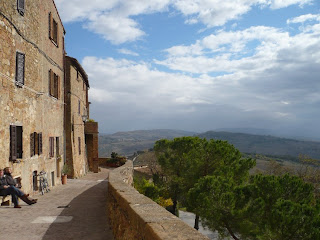
Cloud nine is a big place full of many wonders. I cannot hope to cover our trip adequately, especially not in one post. My best advice: go and see for yourself. Tuscany is magical and it calls to you.
First, let me start with our meals, since that was one of the central motivations for the trip. As with small vehicles, contour plowing, and wiffle ball stadiums, Tuscans do food very well. Perhaps too well. If I lived there the way we lived this weekend, I wouldn’t live very long. I would probably drown in the thermal baths, satiated on homemade pasta and locally-produced wines.
Eating with honorary locals Bodo and Moris, we were often that group at the various restaurants we visited: 7 guys, talking exuberantly, sitting for hours at a table that had been reserved weeks ago and marked with a little card, ordering the entire menu, turning heads of less-informed and un-local-tour-guide-blessed tourists, joking with the waiters, calling out to the owners on a first-name basis, laughing at each other and the rubes who thought they could merely walk up and get a table (most of the restaurants we ate at had between 5 and 10 tables; all were bursting with patrons), eating enough to sink small ships, and drinking enough wine to float ‘em back up.
 Here is a sampling of what we ate. Most of it was “four stars heartily shake the hand of the chef” good. Some of it was “call the cemetery and reserve a spot because I can now die and go to heaven” good. These are of course subjective descriptors and will require further research to refine. I have tried to list them as best as possible in the order in which they would be eaten during a meal. Yes, sometimes we ate the vast majority of things on this list at one sitting. I wish I had photos of all of these dishes to share, but I was too busy eating to remember my camera.
- crostini: small pieces of bread toasted with toppings: olive spread, liver pâté, pecorino (sheep’s cheese, also known in Tuscany as cacio) with chopped nuts, pecorino al tartufo (cheese flavored with truffle , a good example of how man was not born to live on bread alone)
- bruschette: another toasted bread dish, familiar to most, addictive to many; the difference from crostini seems to be that the bread is toasted first and then topped with tomatoes and olive oil, pecorino al tartufo, ricotta and green onions
- salumi misti: mixed cuts of cured meats – salami, prosciutto, culatello (another type of prosciutto), capicola, bresaola, lardo (yes, lardo) - Tuscany, or anywhere in Italy for that matter, is not the best place to keep kosher AND sane
- salad with salsa di acciughe (anchovy sauce)
- zuppa (soup) with pane (bread), fagioli (beans), olio (olive oil), pepe (black pepper), and erba cipollina (chives, or, literally, green little onions)
- cipolle al pane: onions with bread chunks, baked in the oven in terra cotta dishes (a common technique used to perfection in Tuscany)
- pecorino fresco con pancetta: fresh sheep’s cheese (there are three general categorizations of pecorino, which I hope to cover in a future post) baked in the oven with bacon – perhaps both the tastiest and least healthy food I ate all weekend – wow.
- salsiccia alla griglia: grilled sausage
- pici: a homemade pasta special to Tuscany, rolled between the hands, long like spaghetti but thicker; with cinghiale (wild boar) ragu, with briciole (bread crumbs), with aglio and pomodori (garlic and tomatoes). I would probably eat this pasta with mulch or gravel or newspaper pulp. It is wicked good.
- tagliatelle: another homemade pasta, often served with a meat sauce
- maialino di latte: roast suckling pig, served with some of the subcutaneous layer of fat – tasty but not my favorite
- semifreddi: ice-cream-esque dessert that comes in slices like bread
- cantucci e vin santo: small almond biscotti, that may or may not be baked feathers from angel wings, and dessert wine traditional to Tuscany – I think Heaven may be a piazza where you sit all day drinking caffe, eating pecorino, reading La Repubblica, writing postcards, drinking vin santo with cantucci, watching stylish women walk by in stivali (boots).
Stay tuned for more reviews from la Bella Toscana.

While Italians don’t really celebrate Halloween, All Saints’ Day is a national holiday. Because it fell on a Thursday this year, most Italians took one of their favorite (among many) liberties and stretched the day-off into a four-day weekend. Fare il ponte – to make the bridge. Mark and I traveled south to Pienza in Tuscany with friends from the baseball team and a few others, some of whom who have been visiting the area regularly for ten years. Mark and I agree it is one of the best ways to travel in Italy: go with Italians who know where to go, where and what and how to eat and drink, who to talk to, what to see, etc. Thanks especially to our de facto tour guides Bodo, Moris, and Panno.

Cloud nine is a big place full of many wonders. I cannot hope to cover our trip adequately, especially not in one post. My best advice: go and see for yourself. Tuscany is magical and it calls to you.
First, let me start with our meals, since that was one of the central motivations for the trip. As with small vehicles, contour plowing, and wiffle ball stadiums, Tuscans do food very well. Perhaps too well. If I lived there the way we lived this weekend, I wouldn’t live very long. I would probably drown in the thermal baths, satiated on homemade pasta and locally-produced wines.
Eating with honorary locals Bodo and Moris, we were often that group at the various restaurants we visited: 7 guys, talking exuberantly, sitting for hours at a table that had been reserved weeks ago and marked with a little card, ordering the entire menu, turning heads of less-informed and un-local-tour-guide-blessed tourists, joking with the waiters, calling out to the owners on a first-name basis, laughing at each other and the rubes who thought they could merely walk up and get a table (most of the restaurants we ate at had between 5 and 10 tables; all were bursting with patrons), eating enough to sink small ships, and drinking enough wine to float ‘em back up.
 Here is a sampling of what we ate. Most of it was “four stars heartily shake the hand of the chef” good. Some of it was “call the cemetery and reserve a spot because I can now die and go to heaven” good. These are of course subjective descriptors and will require further research to refine. I have tried to list them as best as possible in the order in which they would be eaten during a meal. Yes, sometimes we ate the vast majority of things on this list at one sitting. I wish I had photos of all of these dishes to share, but I was too busy eating to remember my camera.
- crostini: small pieces of bread toasted with toppings: olive spread, liver pâté, pecorino (sheep’s cheese, also known in Tuscany as cacio) with chopped nuts, pecorino al tartufo (cheese flavored with truffle , a good example of how man was not born to live on bread alone)
- bruschette: another toasted bread dish, familiar to most, addictive to many; the difference from crostini seems to be that the bread is toasted first and then topped with tomatoes and olive oil, pecorino al tartufo, ricotta and green onions
- salumi misti: mixed cuts of cured meats – salami, prosciutto, culatello (another type of prosciutto), capicola, bresaola, lardo (yes, lardo) - Tuscany, or anywhere in Italy for that matter, is not the best place to keep kosher AND sane
- salad with salsa di acciughe (anchovy sauce)
- zuppa (soup) with pane (bread), fagioli (beans), olio (olive oil), pepe (black pepper), and erba cipollina (chives, or, literally, green little onions)
- cipolle al pane: onions with bread chunks, baked in the oven in terra cotta dishes (a common technique used to perfection in Tuscany)
- pecorino fresco con pancetta: fresh sheep’s cheese (there are three general categorizations of pecorino, which I hope to cover in a future post) baked in the oven with bacon – perhaps both the tastiest and least healthy food I ate all weekend – wow.
- salsiccia alla griglia: grilled sausage
- pici: a homemade pasta special to Tuscany, rolled between the hands, long like spaghetti but thicker; with cinghiale (wild boar) ragu, with briciole (bread crumbs), with aglio and pomodori (garlic and tomatoes). I would probably eat this pasta with mulch or gravel or newspaper pulp. It is wicked good.
- tagliatelle: another homemade pasta, often served with a meat sauce
- maialino di latte: roast suckling pig, served with some of the subcutaneous layer of fat – tasty but not my favorite
- semifreddi: ice-cream-esque dessert that comes in slices like bread
- cantucci e vin santo: small almond biscotti, that may or may not be baked feathers from angel wings, and dessert wine traditional to Tuscany – I think Heaven may be a piazza where you sit all day drinking caffe, eating pecorino, reading La Repubblica, writing postcards, drinking vin santo with cantucci, watching stylish women walk by in stivali (boots).
Stay tuned for more reviews from la Bella Toscana.

Subscribe to:
Posts (Atom)


